When Will Fashion Fair Cosmetics Be Available Again
spring style
Way Off-white Did Information technology Start
The reboot of your auntie'due south favorite Black beauty brand.
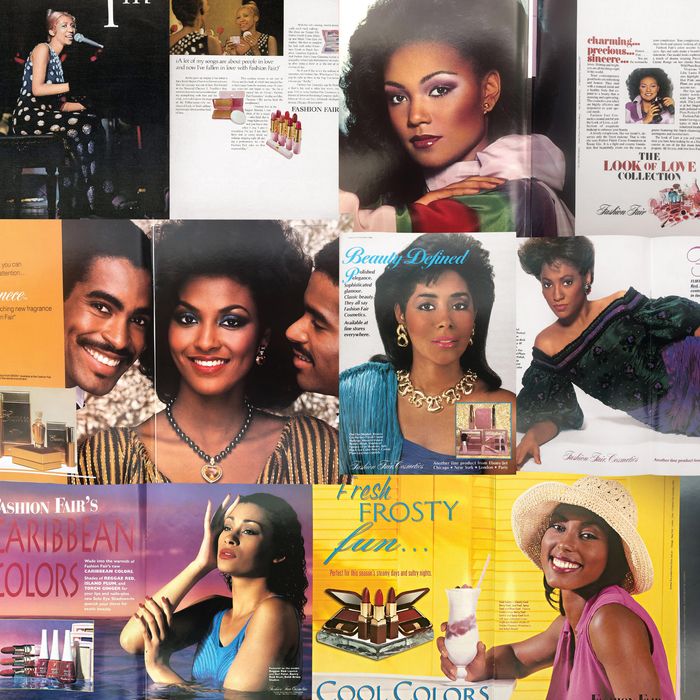
Archival Mode Fair advertisements from the 1970s to the aughts, centering the products on Black consumers. Photo: Via Twitter, 55 Hugger-mugger Street, Chicago History Museum
Archival Way Fair advertisements from the 1970s to the aughts, centering the products on Black consumers. Photo: Via Twitter, 55 Undercover Street, Chicago History Museum
If y'all grew up in a Blackness household during the 1970s and 1980s, yous might remember the ads: Leontyne Price, Judy Pace, Nancy Wilson, Natalie Cole, and others, shimmering across two-folio spreads. They were often pictured gazing into a pink compact, gingerly adorning themselves, some grin in approval and delight, others studied and focused on their application, taking care. Equally Aretha Franklin alleged in hers, "A lot of my songs are about people in beloved, and now I've fallen in dear with Fashion Fair."
Way Off-white was always more than than only a brand of powder and lipstick. Started in 1973 by Black American media royalty — Eunice Walker Johnson, who, with her husband, John Johnson, owned the Johnson Publishing Company, home to Ebony and Jet — Fashion Fair was an extension of Eunice's vision of bringing glamour to a Black audition underserved by the Eurocentric beauty industry. For decades, it was the go-to Blackness dazzler brand. And so, in 2018, with no warning, no explanation, and no good-farewell, Manner Fair cosmetics disappeared. No more Moroccan Spice, Bordeaux, Cerise Vino, and Sweet Maple lipstick shades. No more Chocolate Raspberry.
Last fall, cheers to Desiree Rogers, the Obamas' former White House social secretarial assistant — the beginning Black woman e'er to agree that function, though she didn't hold it for long — Way Off-white officially relaunched in 225 Sephora stores with actress KiKi Layne as its glory ambassador. The new Style Fair is more of a reboot than a revival: vegan, fragrance free, and, with many products at $37, a premium brand fighting for relevance in an increasingly crowded marketplace. In other words, information technology's non your auntie's cosmetics line anymore.
Banner on the Manner Fair website, 2021. Photo: Courtesy of Fashion Fair
The story of Fashion Fair starts with an empire. In 1958, the Johnson Publishing Company started an in-person brand extension and clemency outcome called the Ebony Fashion Fair, which would travel from city to city with models of colour wearing the latest looks. It was at these shows that Eunice Johnson witnessed models backstage concocting their own custom foundations to lucifer their varying brown complexions and saw a business organisation opportunity. Merely Flori Roberts, a white-endemic visitor launched in 1965, and the eponymous Barbara Walden, a Black-owned make launched in 1968, made shades for chocolate-brown and dark-skinned complexions. The darkest foundation mainstream cosmetics brands carried at the time were shades for olive pare, if that. In 1973, Johnson launched Fashion Fair cosmetics to fill that gap.
The company's facial powders had bases in yellowish, ocher, and aureate, and they didn't leave a chalky, cadaverous residual like other makeup. Its lipsticks included colors with warm, deep, rich undertones, introducing a wide variety of shades to department stores for the first time. Finally, women with darker complexions could selection out a foundation that matched their pare tones without having to mix. Past the '80s, other companies would follow accommodate. Simply for many years, the clan with Ebony fix Fashion Off-white apart.
"If you said Ebony mag, that was simply sorta the endorsement for the Style Fair cosmetics line," says author and epitome consultant Alfred Fornay, 78, who worked for JPC for twenty years, including as beauty editor of Ebony and editor-in-main of Ebony Human being. "The two were inseparable." For many years, Fashion Fair could draw on the deep pockets of its parent company to stay competitive with the bigger, white-oriented (and -owned) cosmetics companies. It had direct access to its target audition and non just a clear understanding of its needs and culture but a manus in shaping them. Style Off-white makeup was exclusively used for Ebony fashion and dazzler photo shoots.
Those Fashion Fair ads were in every issue too, reinforcing the mission the line shared with the magazine. "Today, I feel similar I've come full circle," read actress and singer Diahann Carroll'south advertising. "Ebony gave me my first paycheck, I've made the cover of three JPC magazines, and now Fashion Fair has come into my life." In editorials and advertisements, Ebony readers saw images of women like themselves sitting in luxurious living rooms and working equally professionals. The connexion was clear.
Meanwhile, the Ebony Fashion Fair traveled to as many equally xxx cities every year, earning more than $lx 1000000 for African American charities and funding college scholarships over its 51-year run. The twenty-four hours earlier each prove, makeup artists and models would concord promotions and live tutorials at a local department store'due south Way Fair makeup counter, and during the show itself, the announcers would remind the audience that the couture-draped models used Fashion Fair. Customers living in cities where the tour stopped would carry the Ebony Fashion Off-white advertisements into the shop and then they could buy exactly what the models were wearing.
Archival Fashion Fair advertisements centering their products on Black consumers. Via Chicago History Museum.
Archival Style Off-white advertisements centering their products on Black consumers. Via Chicago History Museum.
"We were kind of famous," says Pamela Fernandez, 61, a model and commentator with the show for nearly 12 years, starting time in 1982. "Nosotros had all different peel tones onstage, and we would get those same different peel tones around the counter. Nosotros really connected with each other and only felt our Blackness and loved it."
Rogers, the make's new co-owner (with Cheryl Mayberry McKissack, some other erstwhile JPC executive), remembers the shows from her New Orleans youth. Her female parent, Joyce, won a competition to model in the commencement testify in her hometown, a fund-raiser for a local hospital, just, Rogers recalls, she "chickened out" at the final minute. For Rogers, born in 1959, her generation of immature Black people came of historic period when Ebony Manner Fair cosmetics were the standard of glamour. That'due south what most interested her virtually reviving the line: the rare opportunity to build on its legacy. "I don't want to be greedy," Rogers says. "Merely I want to create a company of scale that lives on well past my lifetime where we're the best of the best."
A well-connected corporate executive with a Harvard M.B.A. and a background in utilities, insurance, tourism, politics, and publishing, Rogers has often been fatigued to ambitious, and sometimes contentious, makeovers of stagnant institutions. During her time in the White Firm, she opened up the social life of the presidency in unprecedented means. In the process, she became well known herself, appearing on all-time-dressed lists and in glossy magazines. Her high contour was a divergence from the social secretaries earlier her, and sometimes she had to be asked to tone it down. On ane occasion, Michelle Obama — her friend of many years — reportedly asked Rogers not to go to a splashy MTV consequence even though she was already on her way in that location. Her time in function lasted only thirteen months; an sharp resignation came after two party crashers breached security at a country dinner in 2009. Every bit she observed to the New York Times in 2010, Washington "is an environs where someone is always looking for someone to make an error."
The following year, Rogers'due south longtime friend Linda Rice Johnson, daughter of John Johnson, recruited her to become chief executive of Johnson Publishing Company. Rogers hadn't worked in the industry earlier, only the family figured what she lacked in experience she fabricated up for with marketing and leadership ability.
Only it wasn't an easy fourth dimension for legacy print magazines, which never really recovered from the advertising driblet-off after the Bully Recession, when readers and advertisers fled to digital. By 2016, JPC sold Ebony and Jet to a private-equity house, which resold them to former NBA thespian Inferior Bridgeman in December 2020. (Ebony continues online.) At the time, Rogers said the magazines had been sold so the visitor could reduce its debt and focus on the growth of the cosmetics business organisation. Rogers left JPC in 2017, and the next yr, Fashion Fair faltered and disappeared from store shelves.
Rogers'due south time at JPC left her intrigued by the possibilities of the cosmetics industry. In 2019, she and Mayberry McKissack teamed up and, backed by hedge-fund executive Alec Litowitz, bought the cosmetics line Black Opal. That same year, JPC went into bankruptcy; a few months later, the pair picked upwards Fashion Fair as part of the Chapter 7 liquidation for $i.85 million. "Manner Off-white is just too valuable for our community to lose," Rogers told the Chicago Sun-Times. "Nosotros plan to modernize the brand and products but will remain truthful to the company'southward roots, which was to create prestige products focused on women of color."
Different when Fashion Fair launched in 1973, it'southward reentering the market in what is arguably the golden historic period of Black beauty products. Fenty Beauty and its skin-tone and gender-inclusive products kick-started a major reckoning in the beauty world, while eastward-commerce and social media lowered the barriers to entry and success for independent Black cosmetics businesses like the Crayon Case and Beauty Bakerie. To modernize the make, Rogers and McKissack brought on dermatologist Dr. Caroline Robinson to incorporate make clean, innovative skin-care ingredients. The new line is vegan and fragrance costless, to the dismay of many original fans who can however recall the cherry smell of their go-to lipstick. The packaging has been updated too, changed from the pink and, later, metallic-bronze shells to minimalist white with aureate trim.
Archival Fashion Off-white advertisements centering their products on Black consumers. Via Chicago History Museum.
Archival Fashion Fair advertisements centering their products on Black consumers. Via Chicago History Museum.
Former Style Fair makeup creative person Sam Fine joined as the brand's global makeup artist, overseeing the new line of products and shades. Fine's goal is non simply to add new shades but to see the nuanced color needs of Fashion Fair's customers. "Just considering you tout 40 and l shades doesn't mean y'all're going to have my color," he says, pointing out the wide range of undertones. The foundation sticks are more buildable and versatile for contouring and spot covering, and the company has added its first primer and four new nude lipstick shades alongside the ten original colors. There are plans to release new blushes, another erstwhile fan favorite.
Today's Manner Fair is also more than mindful of inclusivity beyond race. "We have to make certain that we are open and that we realize this is a new twenty-four hours and time," says Rogers.
While it benefits from nostalgia and name recognition, Fashion Fair nonetheless has a way to go to reclaim its former relevance. The company's YouTube video count is currently six. Some of the older vloggers who were buying makeup when Fashion Fair 1.0 was around expressed disappointment that the relaunch wasn't amend publicized. Even some sometime Ebony Manner Fair models and stans I spoke with hadn't known the products were at present available at Sephora.
Allana Smith, 45, of Brooklyn, discovered Style Off-white cosmetics when she spotted the advertisements in her parents' copies of Ebony and Jet growing up, and she began ownership the makeup at Macy'southward. All the counter artists knew her. One day, she went to Macy's to re-up her Mocha Mocha foundation only to exist told it was out of stock. "Then the weeks turned into months, the months turned into years," she recalls.
Despite saving her products for special occasions and using cotton swabs to excavate drops of precious foundation from their bottles, Smith's personal stock finally dried up while Way Fair was unavailable. Exasperated, she decided to requite newer brands that touted a broad range of shades a shot. She settled on Fenty, and her usual fill-in is Flori Roberts, which she found on Amazon and considers the closest to Fashion Off-white.
At present that Mode Off-white is dorsum, she's excited — but apprehensive. "It's kind of like being in a relationship with someone, and you lot don't desire to take them get up and leave again and so you'll be heartbroken again," she says.
Rogers acknowledges that some customers have moved on to other brands in Manner Fair'southward absenteeism. "Await, you can't change history," she says. "You know, yous tin can say, 'I wished, I hoped,' but the history is what the history is."
Instead, Rogers is looking to the future. This past autumn, designer Anifa Mvuemba marked the tenth ceremony of her luxury womenswear make, Hanifa, with a debut runway show at the National Portrait Gallery in Washington, D.C. Way Fair was the official makeup partner. "It's full circle, right, in terms of how we're thinking about the community," says Rogers. "We're just trying to stick to where we came from but freshen it up, you know? Take it to that adjacent level, create this new microcosm of celebration for our wonderful Black designers and at the same time bring them the all-time that we take."
- Communicable New Yorkers Mid-Delivery
- Let's Get Loftier
- A Bonbon for the Hip
whitleyseentiourcio.blogspot.com
Source: https://www.thecut.com/2022/02/fashion-fair-is-back.html
0 Response to "When Will Fashion Fair Cosmetics Be Available Again"
Post a Comment